SME
RevOps

Most sales teams don’t lose opportunities because they’ve never heard of BANT.
They lose them because qualification is inconsistent.
One salesperson uncovers the budget.
Another forgets to identify the decision-maker.
Someone else takes brilliant discovery notes that never make it into the CRM.
By the time management reviews the pipeline, key information is missing, forecasts are unreliable and opportunities have stalled.
This is where AI is making a genuine difference.
Rather than replacing your sales methodology, AI helps your team execute it consistently capturing information automatically, highlighting qualification gaps and recommending the next best action.
If your goal is to improve lead conversion rather than simply generate more leads, this is where AI delivers real value.
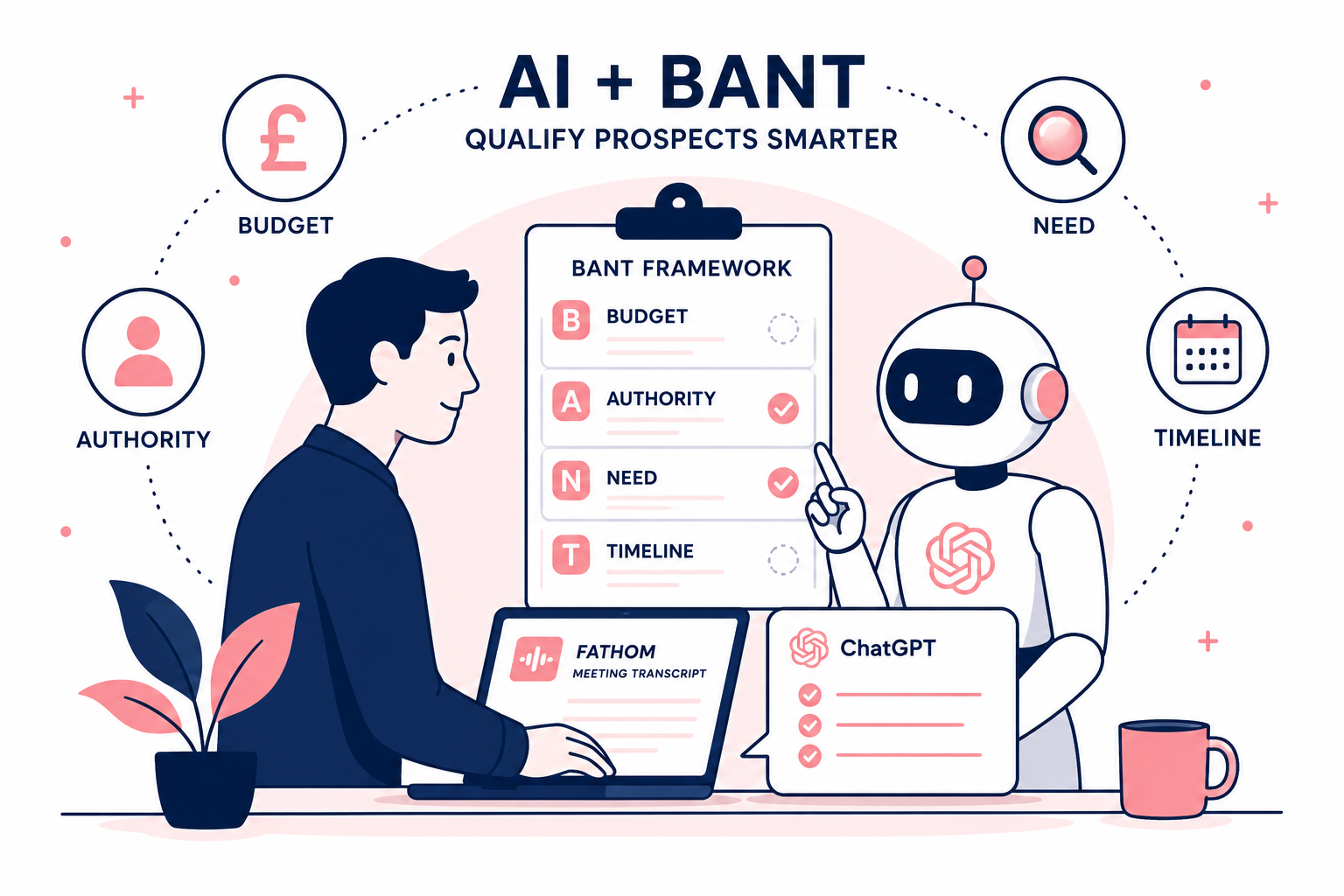
BANT is one of the most established sales qualification frameworks.
Originally developed by IBM, it helps sales teams determine whether an opportunity is worth pursuing by assessing four key areas:
Although BANT has been around for decades, it remains relevant because these four areas still influence whether deals progress or stall.
The challenge isn’t the framework itself.
It’s applying it consistently.
Most salespeople understand BANT.
Few apply it consistently across every opportunity.
That usually isn’t because they lack experience.
It’s because modern sales conversations are busy, complex and involve multiple stakeholders.
Common problems include:
The result?
Opportunities progress through the pipeline without enough information to accurately assess their likelihood of closing.
This challenge becomes even greater as buying decisions involve more stakeholders. Research from Gartner on modern B2B buying groups highlights how purchasing decisions increasingly involve multiple people, making consistent qualification more important than ever.
The real benefit of AI isn’t asking better questions.
It’s ensuring the answers are captured, organised and turned into actionable insights.
AI meeting assistants can automatically identify commercial discussions during calls.
Instead of relying on handwritten notes, AI can capture:
If no financial discussion has taken place, AI can flag the opportunity as having incomplete qualification.
Rather than discovering this weeks later, sales managers can address it immediately.
Modern B2B buying decisions rarely involve one person.
AI can identify:
It can then highlight opportunities where key stakeholders haven’t yet been engaged.
That gives salespeople a clear next step instead of simply hoping the opportunity progresses.
This is where AI arguably delivers the greatest value.
Rather than producing a generic meeting summary, AI can identify:
It can categorise these themes and automatically store them within your CRM.
That creates far richer opportunity records while helping salespeople personalise future conversations.
Many opportunities stall because implementation dates are vague.
AI can identify references such as:
Instead of those comments disappearing into meeting notes, AI can recommend follow-up actions and remind the salesperson when key milestones are approaching.
One of the biggest misconceptions is that AI replaces consultative selling.
It doesn’t.
Great discovery still depends on asking thoughtful questions, listening carefully and understanding the customer’s business.
AI simply removes much of the administration that follows.
It captures information automatically.
Updates CRM records.
Highlights missing qualification.
Suggests follow-up questions.
Identifies risks before opportunities begin to stall.
The salesperson remains focused on building relationships rather than updating systems.
I think this is much stronger. It feels like a genuine discovery call rather than a contrived example, and it’s applicable whether the reader sells consulting, software, financial services or another B2B service.
Imagine you’ve just finished a discovery call with a prospective client.
The meeting has been recorded using Fathom, which has automatically generated a transcript and meeting summary.
During the conversation, the prospect explains that:
Rather than manually reviewing the transcript and updating your CRM, you paste the meeting transcript into ChatGPT using a prompt such as:
“Review this discovery call transcript and qualify the opportunity using the BANT framework. For each area, summarise the evidence provided, identify any missing information, assign a confidence score and recommend the next three questions the salesperson should ask.”
Within seconds, ChatGPT could produce something like this:
Status: Incomplete
The prospect has discussed the business challenges they’re trying to solve but hasn’t confirmed whether budget has been allocated or how investment decisions are funded.
Suggested follow-up questions:
Status: Strong
The Operations Director is leading the evaluation and appears to be the project owner.
The board will make the final investment decision.
Missing information:
Status: Strong
The prospect has identified several business challenges:
These challenges suggest there is a genuine business need and a clear reason for change.
Status: Strong
The prospect wants a solution implemented before the new financial year.
Recommended next step:
Arrange a solution demonstration and stakeholder workshop within the next two weeks to maintain momentum and validate requirements before presenting a proposal.
In just a few minutes, you’ve transformed an hour-long discovery conversation into a structured qualification review.
More importantly, you’ve identified the information that’s still missing before progressing the opportunity.
The salesperson remains focused on asking great questions and building relationships.
AI simply helps organise the conversation, identify qualification gaps and prepare for the next stage of the sales process.
The real opportunity isn’t helping one salesperson qualify one opportunity.
It’s helping every salesperson qualify every opportunity in a consistent way.
For many Sales Managers, one of the biggest challenges isn’t a lack of customer conversations—it’s finding the time to review them.
If every member of the team records their discovery calls using Fathom, those conversations become a valuable source of coaching and sales insight.
Rather than listening to hours of recordings each week, managers can use ChatGPT to review transcripts against a consistent BANT framework.
Every discovery call can be assessed using the same prompt, producing a structured qualification review for every opportunity.
That makes it possible to answer questions such as:
Instead of reviewing a handful of calls each month, managers can analyse trends across dozens—or even hundreds—of customer conversations.
That creates a far more objective view of sales quality.
It also enables coaching based on evidence rather than intuition.
As the process matures, these insights can be taken even further.
Using automation, transcripts could be analysed automatically after every meeting, with BANT scores written back into your CRM, qualification gaps highlighted, follow-up tasks created and managers notified when an opportunity requires attention.
The result isn’t just better meeting notes.
It’s a more consistent sales process, higher-quality CRM data, more effective coaching and greater confidence in your pipeline.
Ultimately, AI doesn’t improve sales by replacing your salespeople.
It improves sales by helping every member of your team apply the same proven qualification process, every time.
A growing number of platforms help sales teams apply qualification frameworks more consistently.
Examples include:
Each approaches qualification slightly differently, but they all reduce the manual effort involved in capturing and managing sales conversations.
The greatest benefit of AI isn’t faster note-taking.
It’s consistency.
Every opportunity is qualified using the same framework.
Every salesperson captures the same information.
Every manager has better visibility into pipeline quality.
Every forecast becomes more reliable.
That’s how AI improves lead conversion.
Not by replacing proven sales methodologies like BANT, but by helping your team execute them consistently and at scale.
If your sales team already uses AI meeting tools or a CRM such as HubSpot, you’re probably collecting far more customer insight than you’re actually using. Features such as HubSpot's Smart Deal Progession are making it easier than ever to capture qualification data automatically—but technology alone won’t improve conversion unless it’s supported by a well-designed sales process.