
CRM
Hubspot
B2B Sales Process
Why More Leads Won’t Solve Your Revenue Problem

Nick Plumley
If your sales pipeline isn’t delivering the results you expect, generating more leads probably isn’t the answer.
For many SME founders and revenue leaders, the first response to slower growth is to invest in more lead generation.
-
More Google Ads.
-
More LinkedIn campaigns.
-
More email outreach.
-
More networking.
But here’s the uncomfortable truth:
More leads don’t automatically create more customers.
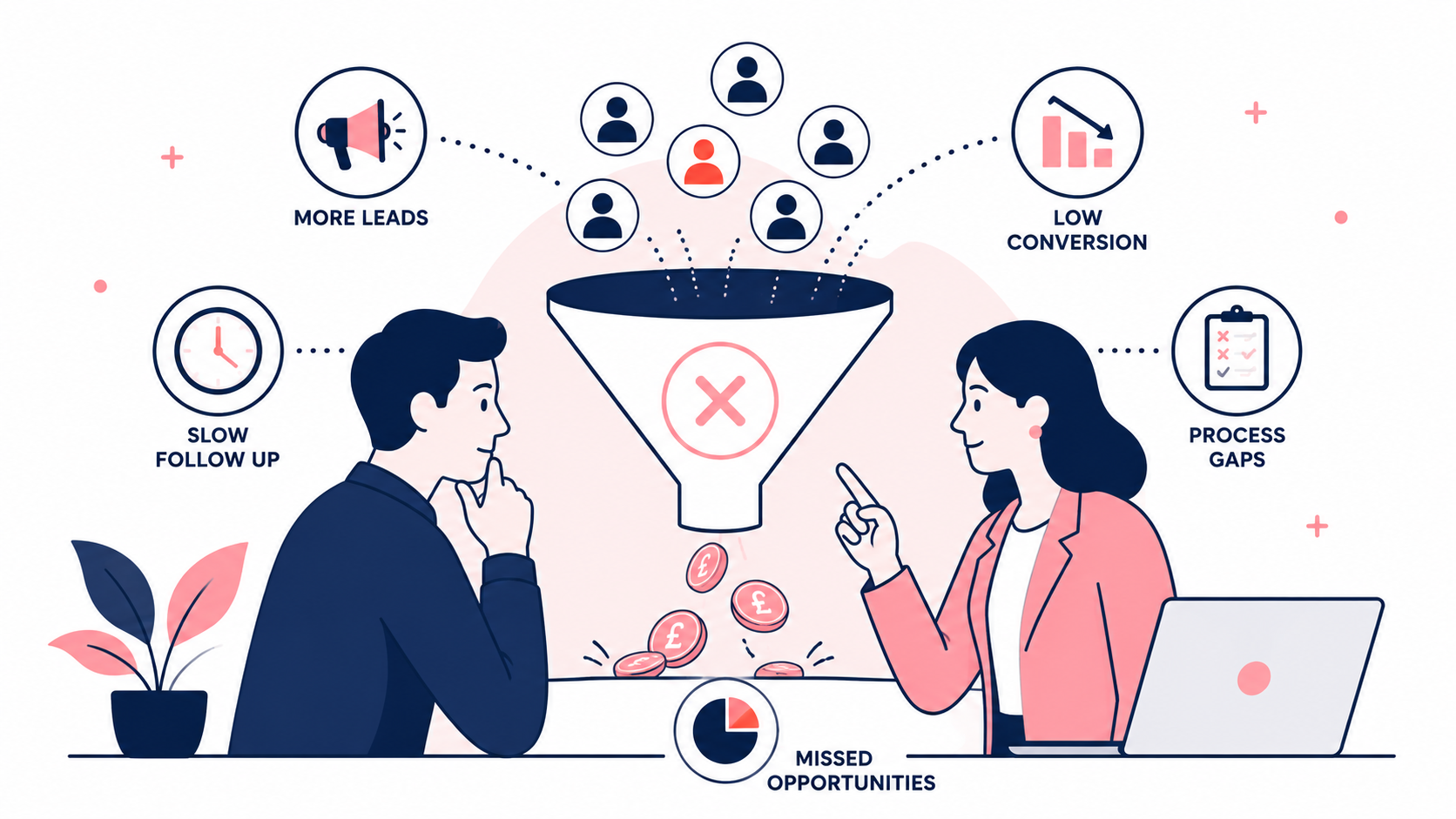
If your business isn’t converting the opportunities you already have, increasing lead volume simply feeds more prospects into a process that isn’t performing as well as it could.
The businesses achieving sustainable growth don’t always generate the most leads. They generate the most value from the leads they already have.
In this article, we’ll explore the common reasons opportunities fail to become customers and the practical steps you can take to improve lead conversion before investing in more demand generation.
The Hidden Cost of Poor Lead Conversion
Every enquiry represents an investment.
Whether that lead came from your website, referrals, networking, paid advertising or outbound sales, you’ve already spent time, money or effort acquiring it.
When opportunities fail to convert, the problem often isn’t the quality of the lead—it’s what happens after the lead enters your sales process.
Common symptoms include:
- Slow responses to new enquiries
- Inconsistent qualification
- Opportunities sitting idle in the pipeline
- Manual follow-up
- Poor CRM data
- Lack of visibility into why deals are won or lost
- Sales teams spending more time on administration than selling
These issues rarely exist in isolation. Together, they create friction throughout the buyer journey, making it harder for opportunities to progress and reducing overall conversion rates.
Seven Reasons Your Business May Be Losing Sales Opportunities
1. Slow Response Times
The speed at which you respond to a new enquiry has a direct impact on conversion.
Prospects are comparing suppliers, gathering information and making decisions quickly. Every hour of delay increases the likelihood that they’ll engage with someone else.
Quick Wins
- Set a response time targets/internal SLAs
- Automate lead handoff.
- Ensure every enquiry has a clear owner.
2. Inconsistent Lead Qualification
Not every enquiry deserves the same level of attention.
Without a consistent qualification process, sales teams often spend valuable time pursuing opportunities that were never likely to convert while overlooking stronger prospects.
Quick Win
Create a simple qualification framework that every salesperson follows before progressing opportunities.
3. Sales Processes That Depend on Memory
Many SMEs still rely on individuals remembering to send emails, arrange follow-up calls or update the CRM.
As businesses grow, this approach becomes increasingly unreliable.
Missed follow-ups are rarely intentional, they’re usually the result of manual processes.
Quick Win
Automate repetitive tasks such as lead assignment, follow-up reminders and meeting scheduling so your team can focus on selling.
4. Sales Teams Aren’t Properly Enabled
Even experienced salespeople struggle without the right support.
Sales enablement isn’t just training. It’s about giving your team consistent messaging, relevant content, buyer insights and practical tools to move opportunities forward.
If every salesperson explains your value differently, prospects receive inconsistent experiences.
Quick Win
Review your sales messaging, create content that answers common buyer questions and ensure every salesperson can confidently communicate your value proposition.
5. Your CRM Isn’t Supporting Better Decisions
A CRM should help your team prioritise opportunities, improve forecasting and provide visibility across the pipeline.
Instead, many businesses treat it as little more than a database.
Poor adoption, incomplete records and inconsistent updates reduce confidence in reporting and make it difficult to identify where opportunities are being lost.
Quick Win
Audit your CRM data, remove duplicate records and establish minimum data standards for every opportunity.
6. You Can’t See Where Deals Are Stalling
If someone asked where opportunities are being lost in your pipeline, could you answer confidently?
Many businesses know how many deals they close but can’t identify where prospects drop out of the sales process.
Without that visibility, improving conversion becomes guesswork.
Quick Win
Track conversion rates between every pipeline stage and review stalled opportunities on a regular basis.
7. AI Isn’t Being Used Where It Delivers the Most Value
AI won’t fix a broken sales process.
However, when built on strong foundations, AI can significantly improve sales productivity and consistency.
From meeting preparation and call summaries to automated follow-up and CRM updates, AI enables sales teams to spend more time building relationships and less time completing administrative tasks.
Quick Win
Start by identifying repetitive manual tasks before investing in AI tools. Automation delivers the greatest return when it supports an already well-defined sales process.
Focus on Conversion Before Generation
One of the biggest misconceptions in B2B sales is that growth depends on generating more leads.
In reality, improving conversion rates often delivers a faster return than increasing marketing spend.
Imagine increasing your lead-to-customer conversion rate by just a small percentage while maintaining the same number of enquiries.
The result is more customers, more revenue and better return on every pound invested in marketing.
That’s why high-performing businesses continually review and improve how opportunities move through their sales process rather than relying solely on generating new demand.
Where Should You Start?
Every business has different barriers to conversion.
For some, it’s slow lead response.
For others, it’s inconsistent qualification, poor CRM adoption, weak sales enablement or limited visibility into pipeline performance.
The challenge isn’t knowing that improvements are possible—it’s knowing which improvements will have the greatest commercial impact.
Rather than guessing, start by identifying the areas that are limiting your business today.
Discover Your Biggest Conversion Opportunity
Our free Lead Conversion Assessment evaluates the key areas that influence sales performance, including lead management, sales enablement, CRM and automation, and pipeline visibility.
In less than five minutes, you’ll receive:
- Your personalised Lead Conversion Performance Score
- A breakdown of your strengths and improvement opportunities
- Practical recommendations tailored to your business
- Clear next steps to help convert more opportunities into customers
If you’re investing in sales and marketing but feel you should be generating more revenue from the opportunities you already have, it’s the ideal place to start.